

Veins of silver in a mountain of sterile
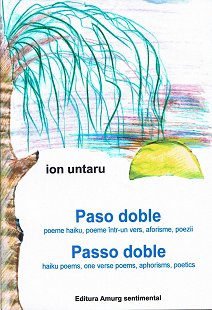
Ion Untaru, Paso doble / Passo Doble; Editura Amurg sentimental, Bucuresti, 2009; translations: Nicholas Dinu, Atlanta, Georgia; ISBN 978-973-678-34807
| ||||||||||||||||
| ||||||||||||||||
|
|



|
Vasile Moldovan |
PUBLICAT DUMINICĂ, 13 IUNIE 2010, ora 10:18
One year after appearance of the book "Birds and words", that enjoyed many comments in haiku magazines from us and elsewhere, John Untaru appears in force with a massive volume of poems. Passo doble is his new visit-card. Poetry here included, written in all genres, with preference for the short type, are in fact a massif mountain, which contains a rich deposit.
As in nature, also in poetry, to get to the essence of beauty, you climb a value scale. The poet tells with charm in a self-impulse: Up, more up / up to God /. This is the great part of the aspiration, the ideal of every respected poet, to have in his own creation, the model even of the Great Creator. But between dream and reality is, generally speaking, an incommensurable distance. The poet himself is aware of the huge effort that must be done, to reach the essence of poetry, when examines, the essence of haiku poem: A mountain / full-sterile / for a single haiku. Be noted from the outset that the mountain of the poet John Untaru contains besides background rock, many rich veins of silver.
The author deals with the same easiness aphorism, the one-verse poem, the poem itself, with rhyme or white verse. He is likened to a performer who plays several instruments, but with varying degrees of virtuosity. Example with aphorisms not convince the auditor (readers), only in part. As per the one-verse poem, where is felt the influence of another poet also from Giurgiu, Dan Florică, John Untaru is more confident and gives us some great beauty micropoeme:
Steel:
Steal spark from stars and light the tinder
Dandelion
An aura scans the flight height
Lamp
Pulsating light as the heart a life
If the Invitation to the castle (Publisher Sagittarius, 1995) and Lotus flower (Signs Publishing, 2006) he publishes poems in fixed form and of high refinement, this book includes poems especially in free verse, rhythmed or not. Theme is of great variety, excel poems rooted in immediate reality. John Untaru, opposite young contemporary poets, addresses life personal drama belonging to poor people, elderly, sick, beggars.
In contrast, he is very modern in poetics. Here he gives us in a few poems, a true aesthetic worth to be known by readers, especially the poets and poetry critics. He speaks about "forgotten words and unwritten poems". The poet lives in a teardrop suspended, breaks syllable by syllable from itself and then builds himself in each of them. After a scattering in words he "learned the lesson of silence". Perhaps inspired by No-words of Nichita Stănescu, John Untaru feel the need, as a poet, to return to words, to relate to them:
the poet is the one who kills the words
and then give them a new life
building them in an hermitage
white as his sleepless nights
Contemporaries have cut the wings of the poet / again /and again / and then again, but he did not give up, so the wings have increased again, this time from within.
The most relevant poem for his poetic art is the most bitter, I render it wholly:
The most bitter
enemy of the poet
remains his own poem
When it is displayed in the public market
most people pass along
and do not take note
Some old people with cane,
read it pensively
and go beyond
But other
considered connoisseurs
throw mud although
they never wrote a poem
The strength of the book is the haiku section. John Untaru proves once again an artisan of fixed forms, as in other collections of poems was an artist of the sonnet and rondel. Constraints of the fixed form help the poet to put aside sterile and choose from reservoir only silver and sometimes gold.
Some of his poems capture the essential lines of haiku aesthetics. Thus, nothing in the world is not absolute. Everything is relative. Everyone relates to other creatures. Even between diametrically opposed entities can establish a relationship. How much difference between an avid globe-trotter who travel round the world and a snail, his house back, that just moves. But here is how close are they in the poet's vision:
Globe-trotter resting
near him passes
a snail
Not only living beings relate to people, but also plants. Here, for example surprised by poet, the communion between man and cherry:
Cherry tree full of fruits
knocking in my glass
he touched its target
Ties are not only between creatures and plants, but also between different worlds, such as cosmos and the animal kingdom:
Summer evening,
a star and a glow-worm
ardently talk
Night on the porch
cicadas and stars
braided destinies
When man breaks law, exceeds its condition and nature, nature is facing him. The poet points out the risk assumed by man when he is not satisfied to be part of nature, but wants at all costs to dominate, to become its master:
Weak knotweed
raises cement slabs
on alley
Clear night
more satellites
than stars
Life and death itself does not exist separately, but coexist, form a tandem. Cross, Christian symbol, signifies the supreme sacrifice of the Son of God for salvation of souls. It symbolizes the death and also predict Resurrection. Everything is in a relative balance:
From the old cross
morning raised
a gentle bud
Interestingly rendered the tandem life / death, phenomena related to war and peace:
After bombardment
all corpses
twinning
Peace -
over the battle line
flocks of pigeons
By Passo doble, John Untaru confirm that is an active poet, with opportunities to strive and overcome its own condition, and reveal essential things in strictly regulated framework of fixed form, especially in haiku and one-verse poem.
© Copyright Vasile Moldovan