

Cassini probe to fly into Saturn moon's icy jets
| ||||
| ||||
|
|




|
News Team |
PUBLICAT MIERCURI, 12 MARTIE 2008, ora 10:31
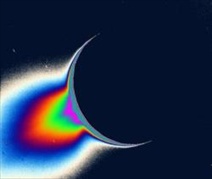
The Cassini spacecraft will fly into mysterious icy plumes erupting from Saturn's moon Enceladus on Wednesday. The flyby, the spacecraft's closest approach to any object so far, could shed light on whether a liquid water ocean – and possibly life – lies beneath the moon's icy surface.
In July 2005, Cassini flew within 175 kilometres of Enceladus's surface, discovering a dozen or so jets spraying water vapour and ice crystals out of warm fissures near the south pole.
That was surprising because moons as small as Enceladus, which is just 500 km wide, do not usually boast enough internal heat to foster such violent volcanic activity. Nonetheless, the existence of the plumes hinted that there might be a liquid water ocean beneath the surface that could provide a toehold for life.
To find out more about the plumes and their origin, mission managers devised a plan to send Cassini flying into the icy jets. On Wednesday, it will carry out the bold mission, passing just 50 km above the moon's equatorial region before flying down the length of the plumes' outer regions, beginning at an altitude of about 200 km (scroll down to see its trajectory).
"This daring flyby requires exquisite technical finesse, but it has the potential to revolutionise our knowledge of the geysers of Enceladus," says Alan Stern, NASA's science chief.
Plume composition
Particle analysers, such as the INMS (Ion and Neutral Mass Spectrometer) and the CDA (Cosmic Dust Analyzer), will study the plumes, collecting data on the density, size, composition and speed of the gas and particles within them.
The plumes' composition might shed light on their source. For example, sodium is abundant in the solar system and should be present in rocky material inside Enceladus. If an ocean exists beneath Enceladus's surface, then researchers argue it should contain a lot of sodium leached out of this material.
If no sodium is found, the plumes may instead be vapour wafting off of relatively warm ice near Enceladus's surface, which, unlike ocean water, might not contain sodium dissolved out of rocks. A magnetometer on the spacecraft will also determine if the moon generates an induced magnetic field from a subsurface ocean.
North pole
Several gases, including water vapour, carbon dioxide and methane have been detected in the vicinity of the plumes. During the flyby, scientists hope to determine the differences in composition between the plumes' own gas and the gas released from the moon's surface when it is hit by particles from Saturn's E-ring – which is densest at Enceladus's orbit.
"This may help answer the question of how the plume formed," says Hunter Waite, principal investigator for the INMS at the Southwest Research Institute in San Antonio, Texas, US.
Cassini's imagers will not be pointed at Enceladus when the spacecraft is closest to the moon, but they will take the first good images of the moon's north polar region when Cassini begins its approach. This will reveal whether the north pole has remnant "tiger stripe" fissures like those on the south pole, which could help solve the mystery of why the plumes erupt only from the south pole.
The closest approach will take place at 2015 GMT on Wednesday. About six hours later, the spacecraft will begin beaming the flyby data back to Earth, a process expected to take 9 hours.
© Copyright News Team
 Sursa : NewScientist.com |