

Saturn's 'flying saucer' moons built of ring material
| ||||
| ||||
|
|




|
News Team |
PUBLICAT SÂMBĂTĂ, 8 DECEMBRIE 2007, ora 20:19
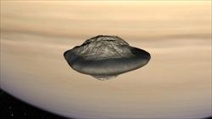
Two of Saturn's small moons look eerily like flying saucers, new observations by the Cassini spacecraft reveal. The moons, which lie within the giant planet's rings, may have come by their strange shape by gradually accumulating ring particles in a ridge around their equators.
The Voyager spacecraft discovered the moons, called Pan and Atlas, in the early 1980s. Pan, which is 33 kilometres wide, orbits Saturn within a gap in the planet's A ring called the Encke Division (scroll down for image), while the 39-km-wide Atlas orbits just outside the A ring.
Both moons have a flattened shape, being wider than they are tall. But their uncanny resemblance to UFOs only became clear recently, when Cassini viewed them with its powerful cameras.
Carolyn Porco, Cassini imaging team leader at the Space Science Institute in Boulder, Colorado, US, says she was looking forward to getting high-resolution images of the moons. "I very much suspected that their shapes might tell us something about their origins," she told New Scientist. "But I never anticipated something that might look like a flying saucer."
The images revealed that the smooth ridges girdling the moons' equators lie in the same plane as Saturn's rings and are also as thick as the vertical distance that the moons appear to travel as they move through the rings.
Now, scientists led by Sébastien Charnoz of the University of Paris in France have run computer simulations suggesting that these ridges are made of material swept up from Saturn's rings.
The origin of the planet's famous rings is still a mystery. But one theory suggests that early in the solar system, one or more large, icy bodies broke up near the planet, creating detritus that then settled into flat rings.
If that is so, Pan and Atlas's cores may have been fragments of this breakup. After the rings flattened into a plane, ring particles may have fallen onto the moons, building up equatorial ridges. The ridges "could be considered as 'fossilised' accretion discs that once may have surrounded Pan and Atlas", the researchers write in the journal Science.
The process probably stopped long ago, since the moons' current orbits are thought to prevent the tenuous material still remaining around them to settle onto their surfaces.
It is not yet clear whether the same process has occurred elsewhere in the solar system. Neptune has several relatively large moons that lie in its ring system, but they have not yet been imaged at high resolution. "One thing we must do when we get back to Neptune is get a very close look at them to see if their shapes also tell us something of their formation," Porco says.
© Copyright News Team
 Sursa : NewScientist.com |