The Birch
|
Patricia Suárez
PUBLICAT DUMINICĂ, 1 OCTOMBRIE 2006, ora 12:14
“When I see birches bend to left and right
Across the lines of straighter darker trees,
I like to think some boy’s swinging them.”
Robert Frost
It was dad who decided I’d be the one to take care of aunt Magda. She had pneumonia and was in bed; she needed someone to look after her. Aunt Magda was dad’s older sister, she was about ten years older than him, and lived in a big house in La Florida.
Back then, I was three months pregnant, and my husband worked in another city: he came every weekend to see me. When I talked to him about my pregnancy, he looked at a gray dot in the distance, and his eyes looked drowsy. He remained circumspect about the subject, but at last he declared it would be better for both of us if he traveled to see me just every other weekend: it would be a way of saving money.
None of us used to question dad’s decisions. Besides, my younger sister is mad at him and hasn’t spoken to him for months –he considers her to be some sort of a black sheep- and my other sister, the older one, has four children. Anyway, it was my older sister –I think she hates me since we were kids because she was always sick and I never got sick- who insisted for me to be the one to take care of aunt Magda. She flattered my nursing virtuosity with such a vehemence that, anyone who would have heard her in a four-league range, would have believed I’m a nursing specialist.
Dad promised to take care of Ferdinand, my dog. It’s a golden retriever that I bought in a Kennel Club Exposition two years ago. The owner wanted to get rid of him at any cost. He had bitten other dogs, and he had lost the medal. He didn’t mind selling it cheap. The dog became my friend right away: I call him Mutt.
Sometimes I tell myself this thing about names is an important issue. In some moments I would like my son to be named Andrew, but then I think the name Andrew stinks. You have to keep in mind a name is to be carried all life long. I know people who hate their parents because of their names. Then I doubt about how should I name my son. I was once told of a woman whose name was Daisy and her three daughters, like herself, had flower names: Dahlia, Violet and Rose. The people who told me that story assure Rose never grew up: she was a midget or retarded, and always looked like an eight-year old girl. She died at 53, they say, playing jump the rope when she had a heart stroke.
It took aunt Magda a while to recognize me. She had to put on her far-range glasses, and then she remembered I was Iris, her middle niece. She didn’t seem very happy to see me. Right away she asked about dad, why dad hadn’t gone to see her. And I told her that was because he was very busy. I told her this, yes, even though I knew dad would be enjoying walking my dog in the park, and the river sight from the dining room window in my apartment.
(A short time ago I dreamed my husband had bought a house in a place called Colonia, which was some sort of a floating city, equidistant to Rosario and Santa Fe, and that it could take minutes to go from Colonia to any city riding the train that went through the hanging bridges. Everybody knows that it’s been a while since we had functioning trains here. When I told him about the dream, my husband just stared at me.)
Anyway, dad hadn’t gone because he was sure aunt Magda was going to die. He’s seen a lot of people recovering from pneumonia, even people older than my aunt, but he could smell Death from afar. It was like that Russian story in which the hero can see Death sitting on the head or the feet of the sick man’s bed, depending on the predicament the man is in. Of course dad hadn’t said anyone aunt Magda was going to die. But he believed so. And he feared so. I knew he knew by the way he avoided us. He didn’t answer our questions directly, nor did he look us straight in the eyes. He ran away from any death signal as if himself or anyone surrounding him were to be eternal. When grandma died, for instance, in ’85, dad was in Sardinia. We never knew exactly why he insisted to take that trip to Sardinia, it wasn’t a place he fervently wanted to visit. I think he would have preferred Tandil to Europe, but he crossed the Ocean, grandma died, and when he came back grandma was already buried and the top of her grave was crowned with chrysanthemums. It didn’t afflict him at all that he didn’t say good-bye to his mother. Afterwards we figured out that dad traveled, ran away to Sardinia, to avoid his mother’s death. He already knew the date in which she was going to die. We know dad has those intuitions.
A nurse came two times a day to take care of aunt Magda. She injected her with an oily potion, and made her take antibiotics. When she talked about aunt Magda, the nurse always called her “the elderly lady”. My aunt had turned eighty-four in March.
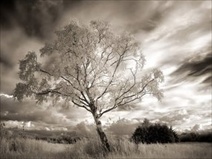
One thing that caught my attention during the time I spent with her was how her skin turned paler and more crystalline. She had the white color of an eggshell. She had been a difficult, wrathful woman. She used to get red with anger every time we went to visit her when we were kids. She enraged about anything: because we touched the ferns, because we stained the delicate linens on which she served us huge cups with milk and cocoa, and which, as if destined, slipped through our fingers. We never wondered why she had remained single: her personality explained it all. As she got older, her only love was the birch tree planted in the patio by the big house’s former owners.
While she was in bed, aunt Magda asked me: Is the tree outside all right? Of course, aunt, I said, How else would it be? Because back then I didn’t imagine that a tree, a birch, could get sick or feel or something like that. She sometimes called it The Emperor. “Did you water The Emperor?” she’d say. When she talked like that I thought that she meant a special kind of birches, like brasil pines or mussolini poplars. Much later I found out there is no species called emperor birch on the face of the earth; it was a name with which she addressed it; a pet name.
One afternoon, she told me the complete story of the big house she lived in. She had bought it when she’d come back from a trip. She had gone to Chile with a friend, Susy, she told me that was her friend’s name. In the past, aunt Magda explained, it was very customary to take a trip when someone wanted to forget a love, an unconvenient one, of course. When they got to Valparaíso, her friend said: Please, Magda, wait for me because I want to wet my feet in the Pacific. She did not like at all that right there, on the boardwalk under the stare of the strollers, her friend took off her garters, her socks, her sandals, and partially pulled up her dress and her slip, just to get her feet wet in the sea, the “Pacific Ocean” as she’d called it. That’s why aunt Magda, wrathful as she was, kept walking and stood under a beach umbrella. She told me she was so angry she felt like crying; but later I thought that maybe it wasn’t the anger that had made her feel like crying, but the oblivion. It is a hypothesis of mine, and maybe I am wrong. She had gone there to forget. And who knows if oblivion doesn’t begin when you retrain from crying.
A salesman passed by and sold her a lottery ticket. She said no at first, then said yes, bartered the price, and finally bought it. She liked the number: 3929; the 29, in lottery means pigeon, and it was her age at the moment. When she came back to Argentina, she knew she was Chile’s lottery second-prize winner: that’s how she bought her house in La Florida.
She spent many days choosing a house, she told me. When she saw this one she knew it was the one she was looking for. She said me: You can tell. You’re worried looking for a house, calculating, and suddenly, once you see the house that’s right for you, a great calm comes over you: as if the house said: we’re made for each other, my love.
The property’s owners were Russian: they had escaped from the Revolution, and assured her that they had had an enormous dacha near Moscow. A dacha with a birch forest. That’s why they planted the tree at the house in La Florida. For the memory. And Aunt Magda bought the house. Oblivion had taken her away and remembrance had brought her back. That’s the way things are.
A month later although she hadn’t improved, she didn’t look worse either. At around nightfall, she asked me: Do you hear The Emperor singing? and I answered Yes. She had named him with a sweet, strange voice, like the tone of language used by lovers and kids. It was autumn and wind was coming from the river. Maybe it would be stormy at night. The nurse came as she did every afternoon, took her temperature and smiled when she read on the thermometer that “the elderly lady” didn’t have as much as a line of fever. It was the only time I saw the nurse smile: big and even teeth like horses’, and pink gums.
The following morning aunt Magda was dead. I don’t know how it happened, I was in the room next door but heard nothing. Anyway, I suppose death, when you’re very old, is like that. Certain and quiet: it passes by and you don’t even hear a scratch. It took me a long time to react, watching the liquids in a mug with tea and honey for her and one with cocoa for me get cold on the kitchen counter. Dad called about ten in the morning. He ignored what had happened to the aunt, and he said: Iris, how is the aunt today? I answered, She died, dad; and he said: I thought so.
I hated dad for having sent me watch a person die, and I swore myself that I was going to leave town, that I’d look for a city like the one I’d seen in my dream and buy a house there that could tell me, like the aunt’s house had told her: We are made for each other, my love.
I am definitely opposed to the idea of selling the aunt’s house. After all, one of us could live there. When I told my husband the story of the big house in La Florida, he said that the Russians had buried a treasure under the birch for sure. A bag with rubles or rupees, I don’t remember now what he called the Russian currency. I told him that if he as much as touched a centimeter of that tree, I was going to leave and he would never see me again. He believed my threat.
Dad says that given the shape of my belly, I’m going to have a baby girl, and he thinks Rossana would be a good name for her. I don’t think so. I haven’t even bothered to listen to him because I know he can’t guess the sex of yet unborned children right. During each pregnancy of my older sister he predicted she’d have a baby boy, and they were four girls. I’ve thought about naming my child Damien, or Joshua, or Darius, I believe those names wouldn’t make me hateful. I don't conceive the idea of my child not being a boy. They say it’s a common wish of all first time mothers. I actually don’t know, actually, I’m not that sure.
© Copyright Patricia Suárez
 |
Nota : | Translated by: Paulo C |
| Sursa : Imagikon
|
Articol preluat din Arhiva SFera Online [sfera.tawil.dev].