World Science Fiction
* This article was first published on Imagikon website. It was an exclusive contribution from Norman Spinrad obtained by Robert David.
|
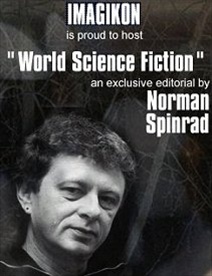

Norman Spinrad
PUBLICAT SÂMBĂTĂ, 9 SEPTEMBRIE 2006, ora 10:20
Science fiction has long been thought of as an Anglophone dominant literature, certainly in the United States, but also in most of western Europe and even Latin America, a literature with its roots in American and to a lesser extent British pulp magazines of the first third of the 20th Century, with a nod to Jules Verne.
For most of the 20th Century, this became a self-fulfilling prophecy. Western European writers of science fiction took this to heart in commercial and even artistic terms, and much non-Anglophone science fiction was written in imitation of the American and British mode. Since imitation is always behind innovation, this more often than not resulted in works that seemed old-fashioned, dated, and derivative.
What was not well-known, or at least not taken into account, until the political shakeups and liberalizations in eastern Europe during the late 1980s and 1990s, was that there had long existed independent national science fictions in countries like Russia, Czechoslovakia, Japan, and Romania, whose roots were quite different from those of British or American science fiction and the western European science fiction so strongly influenced by Anglophone SF.
Without getting into Japanese science fiction, little of which has been translated, and which I know little about, when it comes to eastern European science fiction, or rather, perhaps, science fictions, a few generalities can be made.
One is that post World War II eastern European SF developed largely in isolation, since the countries in question were politically isolated and western (meaning largely Anglophone)SF only penetrated in dribs and drabs, and that with comparatively long time delays from its original publication.
This meant that eastern European science fiction that attempted to mimic western science fiction was actually mimicking western science fiction that was dated by decades, and to read this kind of stuff now, or even when it was first published, is rather embarrassing.
But there was another sort of eastern European science fiction which grew out of the political repression and censorship inflicted on all the arts by the governments of the countries in question--science fiction as political protest, as political satire, as a means of literary expression of political protest, political hopes and dreams.
Science fiction was the ideal literary form for this purpose because it could disguise commentary on present political realities as stories set in other cultures or on other planets in the far future or in outer space. In a politically repressive culture, it was not only inherently subversive, it was the only literature that could really get away with being politically subversive.
In Romania, there was an additional element to the evolution of its national science fiction, namely that it evolved out of a pre-existing and co-existing avant guarde and "experimental" literature rather than primarily out of action adventure pulp magazines meant for adolescent and dominantly male readerships as in the west, and particularly as in the United States.
The lessons in all this for Romanian science fiction writers and would be science fiction writers are several.
First and foremost is that attempts to mimic western science fiction will fail; because what is being mimicked is already long out of date, and because such work can only be derivative and connected to any larger culture only second hand. Particularly futile is the notion that this is somehow the way to sell in the lucrative American market. It isn't. There is plenty of second rate science fiction already being published in the United States written by Americans and imports of such stuff are not required.
Second, while the political conditions that turned science fiction into a kind of literature of coded political commentary and protest have hopefully changed forever and such covert coding is therefore no longer necessary or perhaps even no longer useful, politically engaged science fiction is still a powerful and useful literary mode, and having produced it under difficult circumstances should make it easier to write now in a more forthright manner and perhaps more skillfully that it is generally done in the west.
Third, the relationship with a Romanian avant guarde literature means that Romanian science fiction has benefited and should continue to benefit from its greater stylistic range and sophistication.
In short, my advice to Romanian science fiction writers is to write first hand Romanian science fiction, not second hand western science fiction. Because what most attracts science fiction readers in any country is novelty and the "shock of the new," this, paradoxically, but happily will give you a better chance of success in the west.
© Copyright Norman Spinrad
 Sursa : Imagikon |
Articol preluat din Arhiva SFera Online [sfera.tawil.dev].